
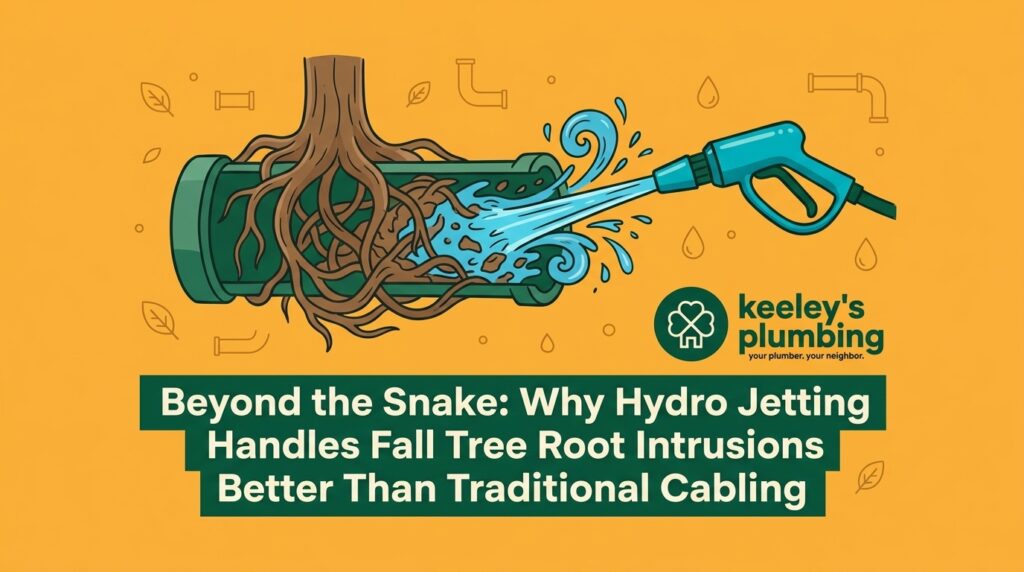
The Seasonal Shift: Why Fall Triggers Sewer Line Nightmares
For our team at Keeley’s Plumbing, helping Lombard homeowners explore solutions for recurring plumbing backups starts with understanding beyond the snake: why hydro jetting handles fall tree root intrusions better than traditional cabling. By mid-fall (October), the air in our region is finally cooling down, bringing welcome relief from the summer heat. But while you are preparing your home for the colder months, a hidden battle is likely taking place right beneath your lawn. Suddenly, the basement floor drain starts gurgling, the toilets become sluggish, and water backs up into the bathtub when the washing machine runs.
In our experience, these sudden symptoms rarely happen by accident. They are the direct result of tree roots aggressively seeking moisture and infiltrating the aging clay sewer lines that connect your home to the municipal system. As surface soils dry out in the autumn air, massive underground root systems shift their focus to the most reliable source of water available: your plumbing.
When faced with a blocked main line, you immediately reach a critical decision point. Do you pay for another temporary cabling job that merely punches a narrow hole through the blockage, or do you invest in a thorough, wall-to-wall pipe cleaning? For homeowners tired of annual emergency calls, the hydro jetting process has emerged as the modern, highly effective alternative to traditional snaking.
The Hidden Symptoms of a Developing Root Blockage
Because your main sewer line is buried deep underground, you cannot see a root intrusion developing. Instead, you have to rely on the secondary warning signs that occur inside your home. Recognizing these early indicators can save you from a complete sewage backup:
- Multiple slow drains: If only one sink is slow, the problem is local. If the kitchen sink, bathroom sink, and shower all drain slowly at the same time, the main line is compromised.
- Unusual gurgling noises: Air gets trapped behind the dense root mass. When water tries to push past it, the displaced air bubbles up through your toilet bowls and drain traps.
- Frequent toilet backups: Toilets require a large volume of water to flush properly. A root-choked pipe simply cannot handle that sudden surge of water, forcing it to back up over the bowl.
- Foul odors in the yard or basement: As organic waste gets trapped in the web of tree roots, it begins to decompose inside the pipe, sending sewer gases back into your home.
Why Mature Trees Target Underground Plumbing
To understand why your plumbing is under attack, we have to look at the basic biology of the trees surrounding your property. Trees are incredibly resilient organisms, and their root systems possess an evolutionary trait called hydrotropism. This means tree roots actively and relentlessly grow toward sources of moisture and oxygen. They do not just wander aimlessly through the dirt; they follow microscopic vapor trails through the soil directly to their source.
In our years of servicing local plumbing systems, we’ve seen how this biological drive becomes highly problematic for Lombard, IL properties with mature trees. Many of the established neighborhoods in our area were built decades ago, utilizing the standard plumbing materials of the time. These aging clay sewer lines feature bell-and-spigot joints that naturally degrade, shift, and settle over decades of use. As the mortar or rubber gaskets between these clay pipe sections deteriorate, warm, nutrient-rich water vapor begins to escape into the surrounding soil. To a thirsty oak, maple, or elm tree, that escaping vapor acts as an irresistible magnet.
The Impact of Fall Soil Conditions
The changing Lombard, IL climate context plays a massive role in this underground dynamic. During the spring and early summer, frequent rains keep the upper layers of soil saturated, satisfying the needs of local trees. However, as we move into autumn, the weather pattern shifts. The surface soil begins to dry out and cool down rapidly.
Facing a lack of surface moisture and preparing for the dormant winter season, mature trees are forced to push their feeder roots deeper into the earth to secure a reliable water supply. These aggressive, hair-like feeder roots follow the vapor trails right up to the degraded joints of your aging clay sewer lines. Because these roots are thinner than a human hair when they first enter the pipe, they easily slip through microscopic cracks. Once inside the warm, nutrient-dense environment of the sewer line, they multiply rapidly, forming a dense, net-like mass that catches toilet paper, grease, and debris.
If you suspect this seasonal shift is affecting your property, learning how to identify the signs of tree root intrusion early can help you address the problem before the pipe completely clogs.
The Limitations of Traditional Drain Snaking for Root Masses
For nearly a century, the standard response to a blocked sewer line has been the mechanical drain snake, also known as a sewer cable or auger. When our plumbers run a heavy-duty steel cable down your cleanout, the goal is to physically break through the obstruction and restore flow. However, when dealing with dense, living root systems inside aging clay sewer lines, we see exactly why this traditional method has severe mechanical limitations.
The fundamental problem with snaking is the way it interacts with the root mass. A sewer cable relies on a cutting head attached to the end of a spinning wire. As the cable is pushed down the pipe, the head pierces and tears at whatever is in front of it. While this is highly effective for retrieving flushed toys or breaking up a localized clump of paper, it is entirely the wrong mechanical action for a sprawling root intrusion.
Why Snaking Fails to Provide a Permanent Fix
A standard residential sewer line is typically four to six inches in diameter. The cutting head on a drain snake is usually only two to three inches wide. When the spinning auger hits a dense wall of tree roots, it bores a small, narrow hole straight through the center of the mass. This immediately allows the backed-up water to drain out, providing you with instant—but temporary—relief.
Because the auger only clears a path as wide as its own head, a significant portion of the roots is left completely intact, clinging tightly to the top and sides of the pipe walls. These peripheral roots act as a net, immediately beginning to catch new debris the next time you flush a toilet. Worse still, the roots that were torn by the auger head respond to the damage by growing back thicker and faster, much like pruning a hedge encourages new, dense growth.
This limitation traps homeowners in a frustrating cycle. You pay for a snaking service in October, the water flows freely for a few months, and by the following fall, the roots have grown back completely, forcing you to call for help all over again. If you are weighing your options between a temporary fix and a permanent solution, comparing drain snaking or hydro jetting reveals exactly why the modern approach is vastly superior for root-heavy lines.
How High-Pressure Water Scours Roots Flush Against the Pipe Wall
At Keeley’s Plumbing, we’ve found that to truly resolve a severe root intrusion, you have to change the mechanical approach entirely. You cannot just pierce a hole through the center of the blockage; you must remove the root mass completely from the interior walls of the pipe. This is exactly what hydro jetting accomplishes.
Instead of relying on a physical metal cutting blade, hydro jetting harnesses the immense power of highly pressurized water. A specialized machine pressurizes water up to 4,000 PSI and forces it through a heavy-duty hose equipped with a precisely engineered nozzle. When our technicians introduce this nozzle into aging clay sewer lines, the results are dramatically different from traditional cabling.
The Mechanics of High-Pressure Pipe Scouring
The secret to hydro jetting lies in the design of the nozzle. It does not just shoot a single stream of water forward. Instead, it utilizes a multi-directional spray pattern designed to clean the entire circumference of the pipe simultaneously.
- The Forward Jet: A single, highly concentrated stream of water shoots straight ahead. This forward jet acts as a powerful drill, punching through the initial root blockage and clearing a path for the nozzle to advance down the line.
- The Rear-Facing Jets: Multiple jets of water are angled backward at exactly the right trajectory to hit the interior walls of the pipe. These rear-facing jets serve two critical purposes. First, they provide the thrust needed to propel the heavy hose deep into the sewer line. Second, they act as high-pressure razor blades, slicing tree roots completely flush with the pipe wall.
- The Scouring Action: As the technician slowly pulls the nozzle back toward the cleanout, the rear-facing jets scour every square inch of the pipe interior. This multi-directional pressure obliterates the peripheral roots that a snake would leave behind.
- Debris Removal: Unlike a snake, which leaves the cut debris sitting in the pipe, the massive volume of water used during hydro jetting flushes all the severed roots, built-up sludge, and accumulated grease out to the municipal sewer main, leaving the pipe completely bare and clean.
By cutting the roots completely flush with the wall of the pipe, hydro jetting essentially resets the clock on the root intrusion. Without a web of peripheral roots left behind to catch debris, your sewer line can function normally for a much longer period, breaking the cycle of constant backups.

Assessing Pipe Health: The Critical First Step
While high-pressure water is the most effective way to eliminate root masses, it is not a tool that can be used blindly. Applying 4,000 PSI of water pressure to an underground pipe is a serious procedure, and it requires strict diagnostic protocols to ensure the safety of your property’s infrastructure.
Before a hydro jetter is ever turned on, a comprehensive visual assessment of the sewer line is absolutely mandatory. Our plumbers use advanced, high-resolution fiber-optic cameras attached to flexible push rods to navigate the twists and turns of your underground plumbing. This video technology transmits a live feed to a monitor above ground, allowing our technicians to see exactly what is happening inside the pipe.
Why We Never Jet Blindly
The camera inspection serves several vital functions. First, it reveals the exact location, density, and severity of the root mass. Second, and most importantly, it verifies the structural integrity of the line itself.
Because our team at Keeley’s Plumbing brings specialized local expertise in diagnosing and treating aging clay sewer lines specific to Lombard homes, you get a customized approach before any high-pressure treatments are applied. Many Lombard, IL properties with mature trees feature original clay pipes that have been in the ground for over fifty years. If the camera reveals that a section of the clay pipe has severely cracked, collapsed, or offset due to soil shifting, applying high-pressure water could cause the weakened pipe to fail completely.
By conducting a thorough professional sewer inspection first, our technicians can confirm that the pipe walls are structurally sound enough to withstand the jetting process. If the pipe is deemed safe, the jetting proceeds, completely clearing the line. If the pipe is severely compromised, we can pinpoint the exact location of the break and recommend a targeted repair, saving you from a disastrous total pipe collapse.
Breaking the Cycle of Yearly Root Intrusions
We know from countless emergency calls that dealing with a backed-up sewer line is one of the most stressful experiences a homeowner can face. The inability to use your sinks, showers, or toilets disrupts your entire household, and the fear of raw sewage damaging your floors and belongings is a constant source of anxiety. When you rely on temporary snaking to clear root intrusions, you are essentially subscribing to this anxiety on an annual basis.
The cumulative frustration and financial toll of scheduling a drain clearing appointment every single fall quickly adds up. You find yourself constantly watching how much toilet paper is used, listening anxiously for the sound of a gurgling drain, and dreading the eventual inevitable backup.
The Long-Term Value of a Scoured Pipe
Choosing to fully scour the pipe walls changes this dynamic entirely. By removing the root mass completely and washing away the sticky sludge that lines the interior of the pipe, you deter immediate root regrowth. Because the roots are cut flush with the clay joints, they have to start their growth process entirely over from scratch, rather than simply expanding from a damaged stump.
This thorough cleaning restores the normal drainage function of your plumbing system for the long haul. Water and waste can flow freely through the full diameter of the pipe, just as it was originally designed to do. As we move deeper into mid-fall (October), proactive maintenance becomes incredibly important. You want to ensure your main sewer line is completely clear and structurally sound before the ground freezes solid for the winter, making any necessary underground excavation significantly more difficult and time-consuming.
Secure Your Sewer Lines Before Winter Arrives
You rely on your plumbing system to work flawlessly every single day. When tree roots compromise that system, you need a solution that provides genuine peace of mind, not just a temporary bandage. By choosing advanced diagnostic methods and high-pressure cleaning over outdated mechanical tearing, you can protect your property from the mess and stress of unexpected sewage backups.
Ultimately, moving beyond the snake: why hydro jetting handles fall tree root intrusions better than traditional cabling is a matter of long-term property protection. If you are experiencing slow drains or gurgling pipes this mid-fall (October), do not wait for a complete blockage to occur. Reach out to our experienced team at Keeley’s Plumbing to explore advanced line clearing options and secure your sewer system before the harsh winter weather sets in.
Frequently Asked Questions
Why do tree roots grow in sewer pipes in the fall?
Tree roots grow into sewer pipes in the fall as they aggressively seek out new sources of moisture. As the summer heat fades and the surface soil dries out, trees push their root systems deeper into the ground to prepare for winter dormancy. They naturally detect the warm water vapor escaping from the tiny cracks and degraded joints of aging underground sewer lines, following that vapor right into the pipe.
Does hydro jetting remove tree roots completely?
Yes, hydro jetting is highly effective at removing tree roots completely from the interior of the pipe. Unlike a mechanical snake that only pokes a narrow hole through the center of a root mass, hydro jetting uses multi-directional, high-pressure water to slice roots flush against the pipe walls. This scouring action leaves the inside of the pipe completely bare and washes all the severed root debris out to the municipal main.
Is hydro jetting safe for old clay pipes?
Hydro jetting is generally safe for old clay pipes, provided a thorough video inspection is performed first. A professional plumber will always run a high-resolution camera down the line to verify the structural integrity of the aging clay before applying water pressure. If the camera reveals that the pipe is already severely cracked, crushed, or collapsed, jetting will not be performed, and alternative repair options will be recommended.
Can roots grow back after hydro jetting?
Roots can eventually grow back after hydro jetting because the microscopic entry points in the pipe joints still exist. However, because hydro jetting cuts the roots entirely flush with the pipe wall, it takes significantly longer for them to grow back compared to traditional snaking. To permanently stop roots from ever returning, the compromised section of the pipe would eventually need to be structurally lined or replaced.
How do I know if roots are blocking my sewer line?
You can usually tell roots are blocking your sewer line when you experience multiple plumbing issues simultaneously across the house. Common warning signs include all your drains emptying very slowly, toilets frequently backing up or lacking flush power, and a distinct gurgling sound coming from the bathtub or basement floor drains when the washing machine is running. Foul sewer odors lingering in your yard or lower levels are also a strong indicator of a severe underground blockage.